The Myth That Every Folk Tune Has One True Version
The idea that every folk tune has one true version obscures how melodies, lyrics, and local habits change as musicians learn and pass them on.
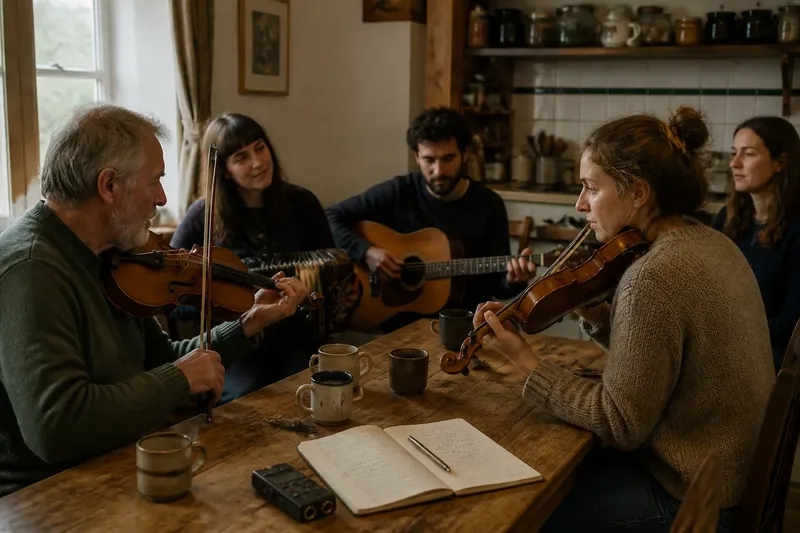
A fiddler starts a familiar dance tune at a kitchen table, and someone across the room answers with a different turn at the end of the phrase. Neither stops to settle which one is correct. That small exchange is a useful place to question the idea that every folk tune has one true version: a tune can remain recognizable while its details travel.
Folk music is often learned by ear, from neighbors, family, sessions, recordings, or a teacher who learned it somewhere else. Each route carries choices. The melody may bend, a lyric may change, and a player may keep a local ornament that another version leaves out. Variation is not automatically a mistake; it can be part of the tune’s life.
What makes a tune recognizable?
Listeners usually identify a melody through a cluster of features rather than a perfect sequence of notes. A distinctive opening contour, a recurring rhythmic shape, a phrase that returns, or a characteristic cadence can keep the tune recognizable even when a player changes a note or two.
That does not mean every alteration preserves the same tune. If the main phrase, rhythm, and structure all shift, listeners may reasonably hear a related tune or a new one. The boundary is often fuzzy, though, and tradition rarely supplies a single clerk to draw it. Familiarity with a particular version can make differences feel larger than they are.
Try listening for the tune’s anchors: the notes that arrive at the same moments, the phrase that circles back, or the rhythmic lilt that gives the melody its character. Then notice what varies around them. This is more useful than treating every deviation from a printed page as a wrong turn.
How does a melody change as it travels?
Learning by ear encourages active memory. A musician may retain the shape and mood of a phrase but not every pitch or ornament. On the next telling, the remembered version becomes the one passed along. A singer might also adjust a line to suit their range, a fiddler might alter a bowing pattern for a dance floor, or a guitarist might reshape the melody to fit the instrument’s open strings.
Place and occasion matter. A tune played for dancing may settle into a firm pulse; the same melody at a slow gathering may acquire longer held notes and a more flexible pace. Singers can stretch syllables differently, and instrumentalists may add decorations that fit their style. These are not mere surface choices when they affect how the music moves and what it invites people to do.
Imagine a player who learns a reel from an older relative, then hears another version at a local session. The player keeps the opening phrase from home, adopts a rhythmic lift from the session, and remembers the final phrase differently after a few weeks. The next time the tune is shared, those choices are audible. The result is an observable new rendition, not proof that one source was faulty.
What should a written or recorded version tell you?
Notation and recordings can preserve a particular performance with useful detail. They can also make one moment look like the final authority. A score fixes pitches and rhythms on the page; a recording fixes one player’s timing, ornament, tuning, and phrasing. Neither can contain every version that came before or might follow.
Read a transcription as a map of one route through the tune. If it includes an editor’s note about a source or a singer’s wording, keep that information attached when you share it. If the source is unknown, say so rather than supplying an invented origin. Clear labels help later listeners distinguish a documented choice from a claim that the tune has one correct form.
For your own notes, record the practical details that help you recover the version: who taught it to you, where you heard it, which phrase differs from another version, and whether you are writing down a melody, a lyric, or an arrangement. A short audio clip can preserve phrasing that notation misses. These notes are not paperwork for its own sake; they keep a personal rendition from being mistaken for the only one.
How can you compare versions without ranking them?
Choose two versions of the same tune and listen for one feature at a time. Compare the opening melody first, then the rhythm, then the ending. If lyrics are involved, listen for changed words, repeated lines, and differences in how syllables sit against the beat. Keeping the comparison narrow makes variation easier to hear without turning it into a contest.
- Mark the phrase that stays most alike across both versions.
- Note where one player adds, removes, or shifts a melodic turn.
- Listen for a different pulse or emphasis, not only different notes.
- Separate a changed lyric from a changed melody.
- Write down what each version is used for, such as dancing, singing together, or solo playing, if you know.
Keep the descriptions neutral. “This version has a longer ending” tells another musician what to listen for; “this is the proper ending” closes the question without evidence. If one version is associated with a particular family, region, or community, name that connection carefully and only when you have a reliable basis for it.
Which version should you learn first?
Start with the version you can hear clearly and want to play. A teacher, a trusted recording, or a session where the tune is played repeatedly can give you a stable starting point. Learning one version in detail helps you recognize later variations; it does not require you to treat that version as universal.
If you are joining a group, ask what version people use before rehearsal or dancing. Listen for the shared opening, number of parts, repeat pattern, and ending. In a session, follow the local arrangement where practical, while remembering that a group’s customary version is a local convention, not a verdict on every other telling.
What is not worth the effort is trying to reconstruct an imaginary pristine form from scattered fragments. Unless the tune has a specific documented source you need to study, endless arguments over which note must have come first can distract from what musicians actually carry forward. Keep the evidence you have, identify uncertainty plainly, and let the tune be played.
What do listeners often ask about folk tune versions?
Can two different melodies still be the same folk tune?
They can, if listeners recognize shared melodic anchors, structure, or a named tradition connecting them. When those features are no longer clear, it may be more accurate to call them related tunes rather than insist on one label.
Does a printed score show the original version?
A score shows the version that was transcribed or arranged, unless its source documentation establishes more. Check its notes about the performer, place, or source before treating it as evidence of an earlier form.
Are ornaments part of the tune or personal style?
They can function as either, depending on the tradition and the player. An ornament may be a local convention, a family habit, an individual choice, or a mixture of these.
How should I label my own arrangement?
Use the tune name if you know it, then describe your version as an arrangement or rendition and credit the source you learned from. If the source is uncertain, say that plainly instead of claiming yours is definitive.
The idea that every folk tune has one true version can make useful listening harder: it directs attention toward errors before anyone has established what the tune’s anchors are. Keep the main search phrase in mind as a question rather than a verdict, and listen for what holds steady alongside what changes. A tune’s history may be carried not only by its notes, but by the people who choose how to pass them on.