Before the Studio: How Musicians Captured Sound
Before the studio, sound capture depended on a horn, a vibrating diaphragm, and a performer’s position. See how electrical recording changed the process.
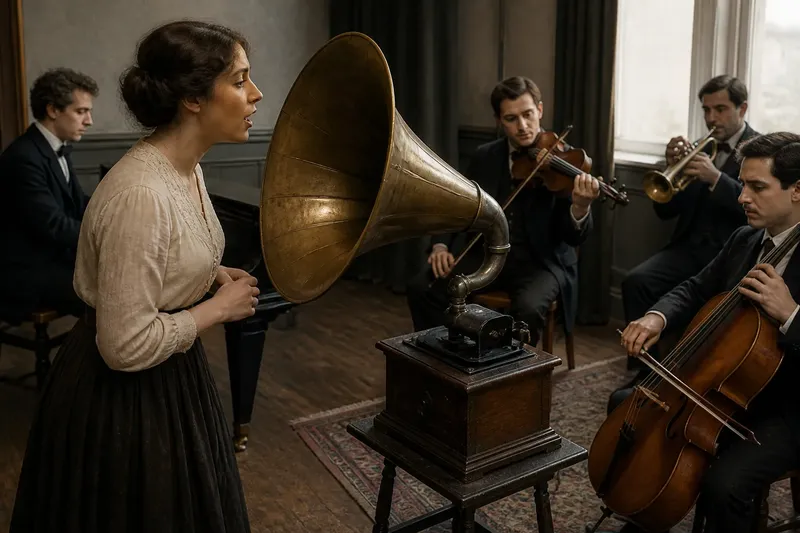
A singer leans toward a brass horn while a violinist edges back, trying not to overwhelm the voice. Before the studio, sound capture was a physical arrangement: performers sent vibrations through air into a machine that had to respond directly. Understanding that early process makes the later shift to electrical recording easier to hear—and clarifies why recording still involves choices about space, balance, and performance.
Why does an early recording sound thin or unbalanced?
The earliest recording systems had no microphone or electronic amplifier. A large horn gathered sound and directed it to a diaphragm, a thin membrane that vibrated in response. A stylus connected to the diaphragm traced those vibrations into a rotating recording surface. The result was a record of sound made by direct mechanical motion.
That arrangement favored some sounds over others. A horn responds unevenly across the range of pitches and loudness it can capture, so a strong, bright instrument might register clearly while a softer or lower one receded. The difficulty was not simply that performers played badly; the recording apparatus shaped the balance before anyone could listen back.
What to try in the historical setup was physical rather than electronic: move a source nearer or farther from the horn, turn it toward the opening, or change the ensemble’s arrangement. Musicians might place a singer close and position a quieter instrument where the horn could collect it. There was no separate channel for each performer, so one adjustment could change the whole ensemble’s blend.
What happens when the performance is too loud?
A recording diaphragm and stylus could only move so far while tracing the groove. A forceful sound might exceed the mechanism’s useful range, producing a rough or distorted result. The problem was especially awkward because a recording session offered little opportunity to isolate the loud source after it had been captured.
The practical response was to manage the sound at its source. A player could ease back, an instrument could be moved away, or the ensemble could alter its placement. These are examples of performance and arrangement decisions serving the recording, not later repairs. In an acoustic session, the room and the horn were part of the signal path, and performers had to work with both.
Imagine a small ensemble with a brass player who dominates a singer at the horn. The players could move the brass instrument farther away and angle the singer toward the opening; the expected observable result would be a more legible vocal line on the captured disc. That adjustment would not create independent control over each source, but it could improve the combined sound before the stylus made its trace.
Why is it hard to change a recorded balance later?
In direct acoustic recording, the stylus inscribed the combined performance as it happened. The voice, instruments, room reflections, and mechanical limits all contributed to one physical trace. If the singer was buried, there was no separate vocal track waiting to be raised after the session.
This is why placement and timing mattered so much. Performers could repeat a take, revise their arrangement, or adjust their distance from the horn, but each new attempt captured another complete performance. The method rewarded ensembles that could listen to one another and shape their dynamics together.
It also explains a common misconception: early recording was not simply a modern studio session with older equipment. The recording medium and the performance were tightly joined. Decisions that later could be treated as mixing choices had to be made in the room, in real time.
What changed with electrical recording?
Electrical recording replaced the acoustic horn as the principal means of capturing sound with a microphone and electronic amplification. A microphone converted sound pressure into an electrical signal; that signal could be amplified and used to drive the recording apparatus. This made it possible to capture a broader and more controllable range of sounds than the horn-based system could manage.
The change did not make placement irrelevant. Microphone distance, direction, room sound, and ensemble balance still shaped the result. But electrical equipment gave recording engineers a more flexible way to capture quieter sources and to work with sound that did not suit the old horn’s limitations. Recording began to depend less on forcing every performer into one acoustic sweet spot.
Amplification also changed what could be heard during a session. Instead of relying only on sound traveling directly to the recording horn, a microphone could pick up a source and send its signal onward through electronic equipment. The precise equipment and recording process varied, but the central shift was from mechanical collection at the horn to electrical capture and amplification.
How did the new method affect performance?
Electrical recording expanded the range of possible arrangements, but it did not erase the value of a well-balanced performance. Players still had to make expressive choices, listen closely, and respond to one another. The difference was that the recording process offered more ways to capture sound without requiring every source to fit the same narrow acoustic pattern.
For listeners, this shift is useful context when comparing early records with later recordings. A thin or crowded sound may reflect the limits of the capture method as much as the style of the musicians. A clearer recording does not automatically mean a more skillful performance; it may show that the equipment could represent more of what happened in the room.
What do listeners often ask about early sound capture?
Did early recording use microphones?
The earliest acoustic systems gathered sound through a horn and transferred its motion mechanically to a diaphragm and stylus. Microphones became part of the process with electrical recording.
Could musicians record separate instrument tracks?
In direct acoustic recording, the ensemble’s combined sound was captured together rather than stored as independent tracks. Performers shaped the balance through their placement, dynamics, and arrangement.
Why did performers move around the horn?
Distance and direction affected how strongly each source reached the recording mechanism. Moving closer or farther was a practical way to adjust the ensemble’s captured balance.
Did electrical recording remove the need for careful placement?
No. Microphones and amplification widened the available options, but placement and room sound continued to influence what the recording captured. The equipment changed the choices available; it did not make listening and arrangement unnecessary.
Which early constraints still matter in a studio?
Modern recording offers tools that early musicians did not have, yet the older process remains a useful reminder: a recording begins with sound in a space. Before reaching for a plug-in or changing a level, consider whether a source is too close, too far away, or competing with another sound. A small adjustment to the performance or placement may address the cause more directly.
What is not worth the effort is treating every older recording as a puzzle that must be corrected into modern clarity. Narrow bandwidth, audible surface noise, and a tightly blended ensemble can be part of the sound’s character as well as evidence of its capture method. When listening, notice how the recording’s limitations shape your attention; when making music, use the same awareness to decide which limitations you want to keep.
Before the studio, sound capture meant arranging people and instruments around a machine that could only record what reached it. Electrical recording loosened that constraint, but the basic question remains: what should the listener hear first? Answering it begins with the sound itself, not just the equipment.